
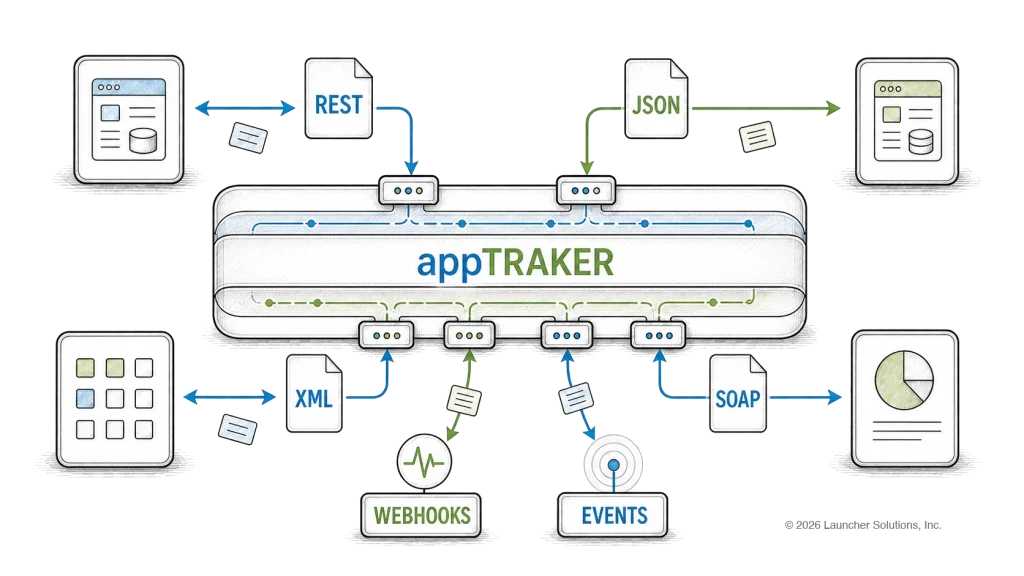
What the appTRAKER API supports
A lending operation rarely runs on one system. appTRAKER APIs and implementation-specific interfaces let authorized channels, partners and downstream systems exchange supported information directly with appTRAKER.
The available objects and actions depend on the interface, permissions and implementation. Common REST patterns include:
Other data exchanges may be delivered through a supported connector, scheduled export or implementation-specific interface rather than the public REST pattern.
Applications from more than one channel
Applications may begin in myLOAN, Dealer Portal, Dealertrack, RouteOne, a lender-operated experience or another authorized source.
appTRAKER provides the origination record and routes the application through the workflow configured for that source and lending program — the mechanism behind multi-channel work such as indirect auto lending.
Keep downstream systems downstream
appTRAKER manages origination. Core banking, servicing, card, accounting, content-management and data platforms continue managing their own responsibilities.
At the appropriate point in the lender process, an interface can send approved customer, loan, collateral, document or booking information to the downstream system. The trigger, direction and payload are defined for the implementation; not every integration exchanges the same data or operates in both directions.
Data exchange with context
An interface should do more than move fields. LAUNCHER maps the exchange to the business event around it: application intake, underwriting, verification, document delivery, funding, booking or portfolio reporting.
Validation, matching, error handling and operational ownership are settled as part of the implementation, because those are the things that determine whether an integration still works six months later.
Access and control
API access is limited to authorized users and systems. Credentials, permissions, available operations and data scope are established for each connection.
Applicable environment security and control information is maintained in the Trust Center.
A practical integration process
Every connection follows the same sequence, whatever the method:
Every interface is documented before it is committed
Interface scope is documented for the implementation, including objects, fields, direction, timing, error handling, monitoring and ownership.
So LAUNCHER reviews the use case, confirms the supported method and documents the interface before anything is committed. That document is what both sides build against — see the wider integration landscape for the providers already connected.
Frequently asked questions about the appTRAKER API
Can an external system submit applications to appTRAKER?
Yes. Authorized systems can submit applications through supported application-intake methods, including REST and other established interfaces.
Can a borrower or dealer experience display application status?
Supported status information can be retrieved for an authorized connected experience. The exposed status and wording should be mapped to the audience rather than assuming internal workflow labels belong outside the LOS.
Can the API update an existing application?
REST supports updates to defined portions of the application, including supported loan request, trade-in, vehicle and collateral data. Each integration exposes the authorized methods and fields defined for its workflow.
Can documents be sent to appTRAKER?
Yes. Supported document-submission methods can associate files with the applicable application.
Does every integration work the same way?
No. Some connections use real-time APIs; others use supported partner interfaces, files, scheduled exchanges or lender-specific implementation work. LAUNCHER confirms the role, scope and operating model of each connection.
Who owns an integration once it is live?
Monitoring and operational ownership are agreed before production use, so a failed exchange has a known owner rather than surfacing as an unexplained gap in the workflow.