
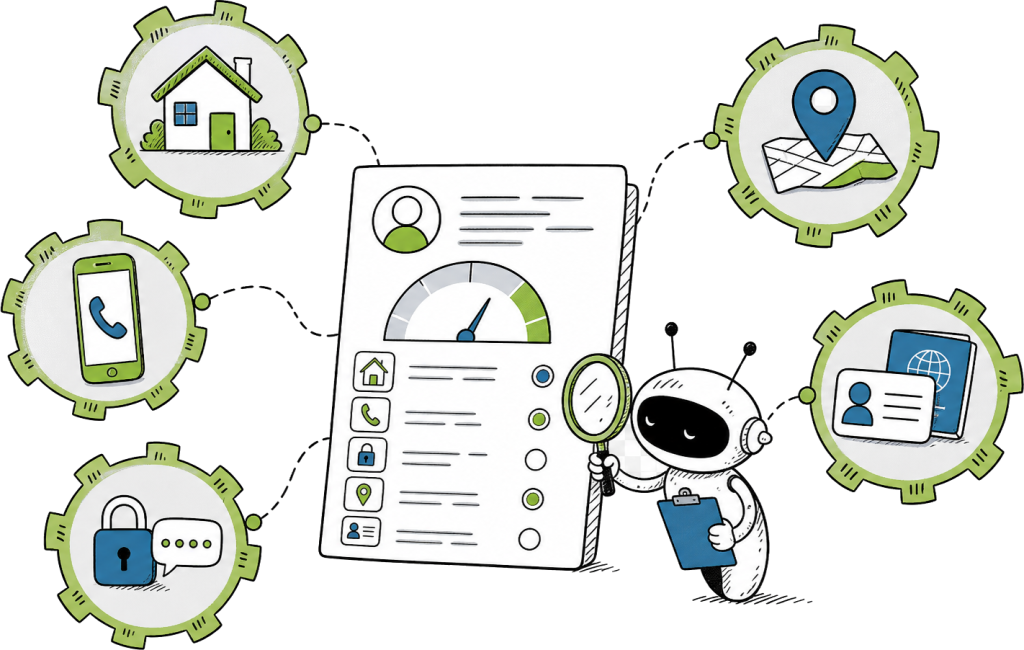
A combined view of relevant signals
Fraud rarely announces itself with one decisive flag. Reviewers need related signals in context: whether an address is deliverable, whether a phone appears valid and belongs to the applicant, whether the applicant can prove possession of it, whether location data is consistent and whether the credit bureau returned identity warnings.
appTRAKER Fraud Intelligence organizes those results inside the loan application so lenders can investigate inconsistencies and route the right cases for additional review. Depending on configuration, data availability and applicable consent, the review can include:
The value comes from the pattern. A single mismatch may have an innocent explanation; several related inconsistencies may justify a closer look.
One score, with its drivers visible
Fraud Intelligence uses a normalized 0–100 confidence framework. Individual categories keep their own scores while contributing to the overall assessment, so a reviewer sees both the result and what produced it.
A number nobody can explain is a number nobody should act on. The drivers stay visible precisely so the score can be questioned.
Keep the evidence with the application
Results remain connected to the applicant and transaction for review, workflow and audit history. Authorized users can review the available evidence, see verification status and use it alongside credit and underwriting information inside appTRAKER.
Turn findings into work
Fraud Intelligence supports the lender decision process. Rules and workflows can use results to request verification, add a task or stipulation, route an application to a specialist, or require another approval before the transaction moves forward.
A signal that changes nothing is a signal nobody reads. Findings become work items attached to the application, with an owner and a state.
Phone-possession verification
Where enabled and supported by consent, an applicant can receive a one-time passcode. The result records whether the challenge was completed, failed or expired.
That is a different question from whether a number is associated with a name, and a more useful one: OTP completion records evidence that the applicant controlled the phone during the verification event.
Designed for controlled access
Fraud and identity data can be limited through appTRAKER security roles. Access and activity remain within the same operational and audit environment used for the application, so who looked at what is answerable.
Handling of sensitive applicant data is covered in the Trust Center.
Signals with review context
Fraud Intelligence combines multiple indicators and presents their drivers so lenders can apply consistent review policy. Lenders retain responsibility for the final identity and fraud determination.
One fraud dashboard inside appTRAKER
Fraud Intelligence brings identity, phone, address, location and bureau signals together, evaluates them in context, and presents the result directly inside the lending workflow — one review environment, one audit trail, one place where the evidence and the application meet.
Frequently asked questions about Fraud Intelligence
Does Fraud Intelligence make the credit decision?
No. It provides information that can support rules, verification and human review. The lender controls the credit and fraud-review policy.
Does one failed check mean an applicant is fraudulent?
No. A single mismatch may have an innocent explanation. The review is built around related signals evaluated together, and no single result independently proves identity or fraud.
How does the Fraud Intelligence score work?
Fraud Intelligence uses a normalized 0–100 confidence framework. Individual categories can maintain their own scores while contributing to the overall assessment, allowing users to see both the result and its underlying drivers.
Is Fraud Intelligence an underwriting score?
No. It evaluates fraud and identity-verification confidence. It does not replace the lender credit policy, underwriting criteria, credit scorecards or other credit-risk models.
Is applicant consent relevant?
Yes. The collection and use of some phone, location or verification data may depend on the lender workflow, disclosures and applicable consent.
Can access be restricted?
Yes. appTRAKER roles can control who may view or act on fraud and identity information.
Does it work with direct and indirect applications?
Yes. Fraud Intelligence can support multiple origination channels. The available signals and consent process may vary depending on whether an application arrives through myLOAN, Dealer Portal, an API or another channel. It applies the same way to dealer-originated transactions as to direct ones.
Can Fraud Intelligence be used during funding?
Yes. It can participate in funding-validation workflows to provide additional fraud and identity information before a transaction completes.